

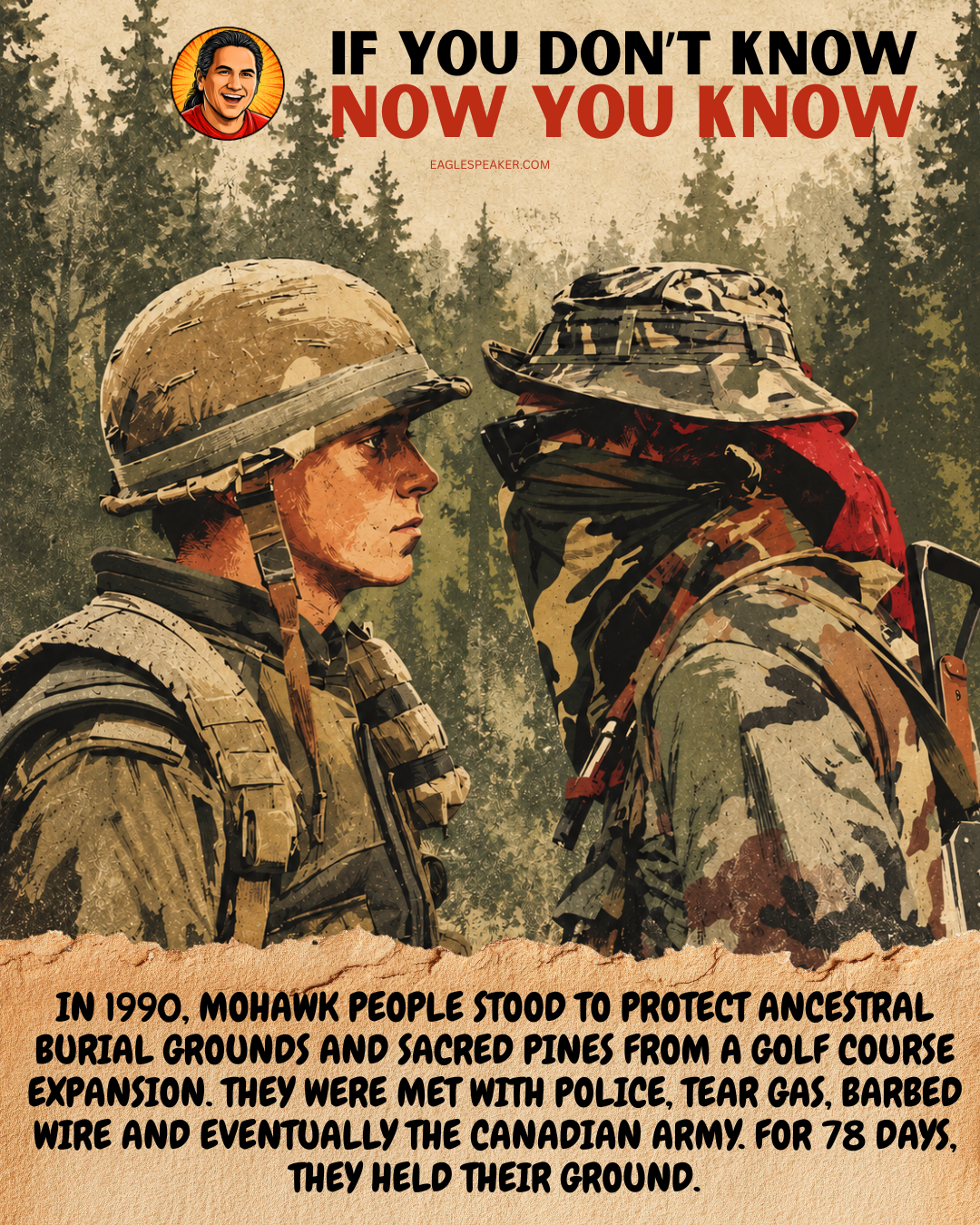
In the summer of 1990, the world watched as the Mohawk of Kanehsatà:ke and Kahnawà:ke stood face to face with the full force of the Canadian military.
It started with something so small it almost sounds ridiculous... a plan to expand a golf course. But that “plan” meant cutting into Mohawk burial grounds and sacred pines that had stood for centuries. So when the bulldozers rolled in, the people stood up. Elders, women, and warriors - generations united - and they built barricades across the road.
They weren’t asking for violence.
They were demanding respect.
They were defending their ancestors.
The Sûreté du Québec moved in first, armed to the teeth. Then came the RCMP. When their assault failed, the Canadian Army moved in with tanks, helicopters, rifles, and barbed wire. For 78 days, families, elders, women, and warriors faced down one of the most powerful militaries in the world.
Tear gas.
Rubber bullets.
Floodlights at night.
Media calling them “terrorists.”
And yet... they stood.
This wasn’t chaos. It was ceremony. Women led songs. Children prayed. Warriors stood guard. The land was defended with dignity and strength... but the cost was heavy.
During one chaotic moment, a young Mohawk girl named Waneek Horn-Miller, just 14 years old, was stabbed in the chest with a soldier’s bayonet while she carried her 4-year-old sister. That image - a child bleeding, her sister screaming - exposed the truth for the world to see: this was not “peacekeeping.” It was colonial violence in real time.
The government called it the Oka Crisis. But to the people, it was the Oka Resistance... a battle for identity, for sovereignty, for land that was never surrendered.
When the barricades finally came down, the message didn’t fade. It spread. From Oka came Ipperwash, Gustafsen Lake, Wet’suwet’en, and Standing Rock... each one echoing that same spirit: we are still here, and we will not be erased.
The Oka Resistance wasn’t just a protest. It was a mirror... showing so-called Canada exactly what it looks like when you fight the people who refuse to disappear.
