

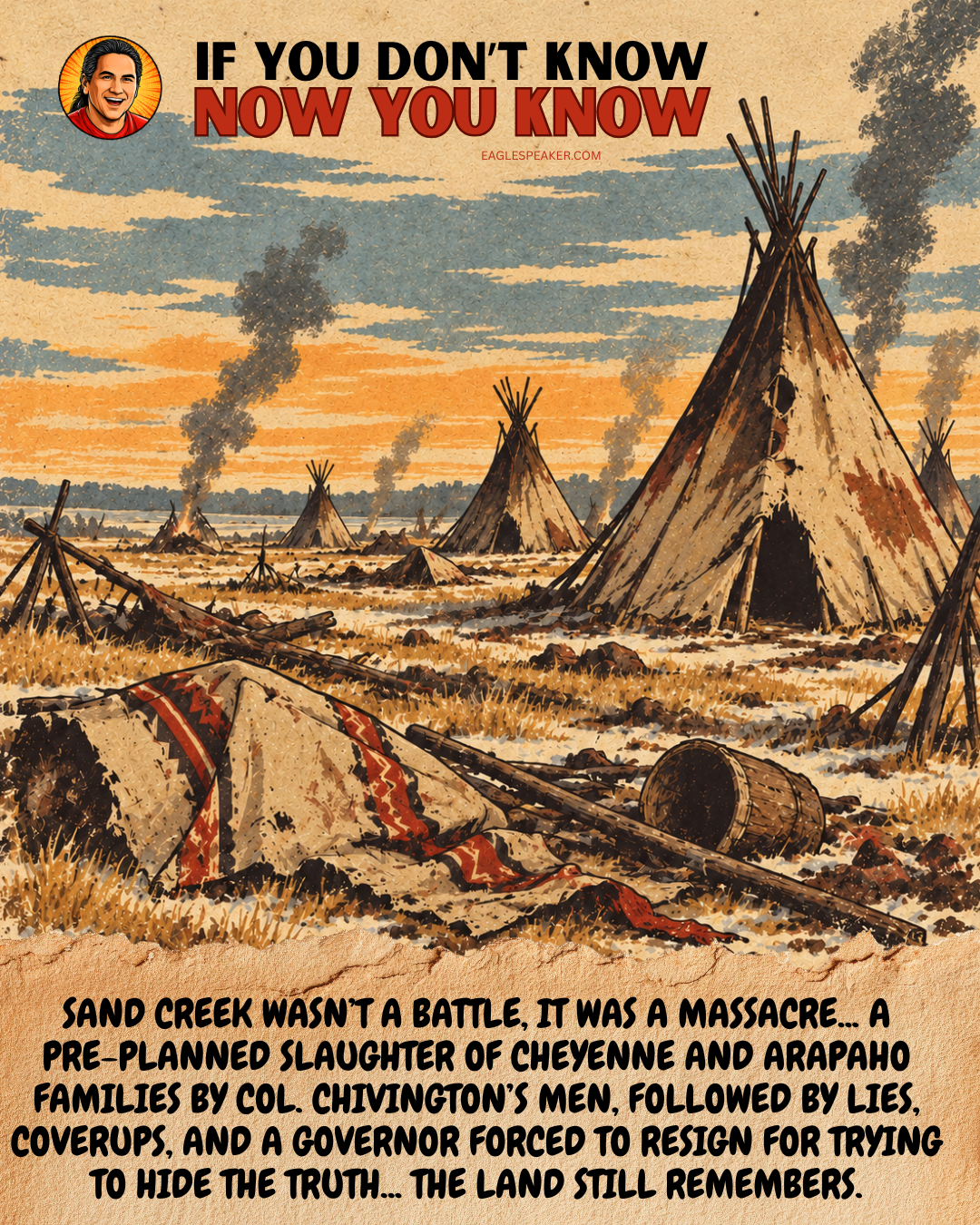
November 29, 1864. Sand Creek. So-called Colorado.
Just before sunrise, Col. John Chivington brought roughly 675 soldiers down on a Cheyenne and Arapaho village of about 700 people. These weren’t warriors lined up for battle. These were families. Women. Children. Elders. People who had been trying to make peace and had been told by U.S. officials where to camp.
Black Kettle raised an American flag that had been given to him as a sign of protection. He raised a white flag beside it.
Didn’t matter.
Chivington’s men opened fire anyway.
People ran into the dry creek bed and started digging into the sand with their hands, trying to make anything that might stop a bullet. Soldiers fired down into them from both sides. The killing went on for hours.
HOURS!!!
More than 230 Cheyenne and Arapaho people were killed. Around 150 were women, children, and elders... and then these "men" did what men like this always seem to do when they think nobody is going to hold them accountable.
They mutilated bodies.
They took human remains as trophies.
They stole horses.
They destroyed the camp.
Some of those remains were later displayed publicly like souvenirs... and then Chivington tried to call it a victory.
Nah.
Even some of his own soldiers knew exactly what they had witnessed. Captain Silas Soule refused to order his men into the attack. Later, he testified about Sand Creek and helped expose the lies being told about what happened there... a few months later, Soule was murdered in Denver.
That’s how ugly this story is.
At first, Chivington and his supporters tried to sell Sand Creek as some heroic frontier battle against hostile Indians. But once testimony started coming out, that story fell apart fast. Congressional and military investigations exposed what happened: a village full of families, including people who believed they were under U.S. protection, had been attacked and slaughtered.
Today, Sand Creek is protected as a National Historic Site, but official markers only tell part of the story. People around Sand Creek have been telling stories for generations. Dogs barking where there are no dogs. Women and children crying out across the prairie. Figures appearing through the darkness. Campfires flickering in the distance, then disappearing when you get closer.
Some places carry what happened to them. Some land remembers. Sand Creek has a lot to remember. Because this wasn’t a battle. It was betrayal.
People were told they would be safe. They raised an American flag. They raised a white flag. They asked for peace... and they were slaughtered anyway.
Some places remember.
Sand Creek is one of them.
