

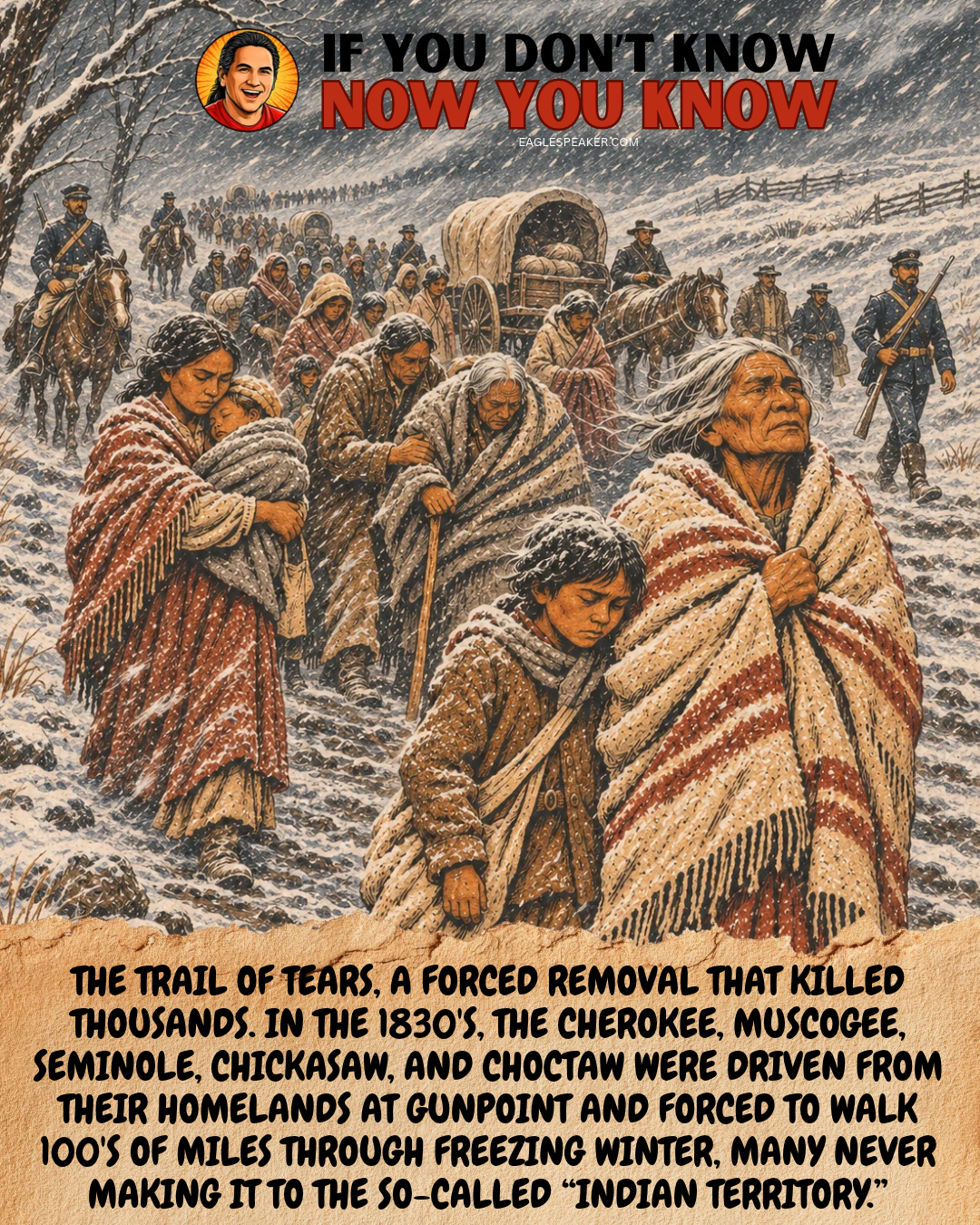
The Trail of Tears wasn’t just a tragic chapter... it was a government-sanctioned act of brutality.
In the 1830s, under the Indian Removal Act, the United States forced the Cherokee, Muscogee (Creek), Seminole, Chickasaw, and Choctaw Nations from their homelands in the Southeast to what was called “Indian Territory”... present-day Oklahoma. The government wanted fertile land for cotton. White settlers wanted expansion. And the policy was simple: remove the people already living there.
They came with soldiers. Burned villages. Destroyed crops. Families were rounded up with bayonets and guns... given minutes to gather what they could carry. Children were separated. Elders collapsed on the road. Disease tore through camps. Some froze to death at night while guards kept them moving by rifle point.
Over 100,000 people were forced to march west. Historians estimate that one in four never made it. Entire Nations were reshaped by death, hunger, and grief.
But even in that darkness, there was resistance. Some refused to leave. They hid deep in the forests and swamps, surviving off the land... and that’s how the Mississippi Choctaw remained. Their ancestors stayed behind, refusing to abandon their home, their language, and their burial grounds.
The Trail of Tears wasn’t just about relocation. It was about breaking Nations to steal their land... and still, they endured. They rebuilt towns, schools, governments, and lives from the ashes. They carried songs, ceremonies, and strength across miles of suffering.
This wasn’t “the past.” It’s blood memory. It’s why every time we speak our languages, stand on our land, or pass down our stories, we defy that trail all over again.
